
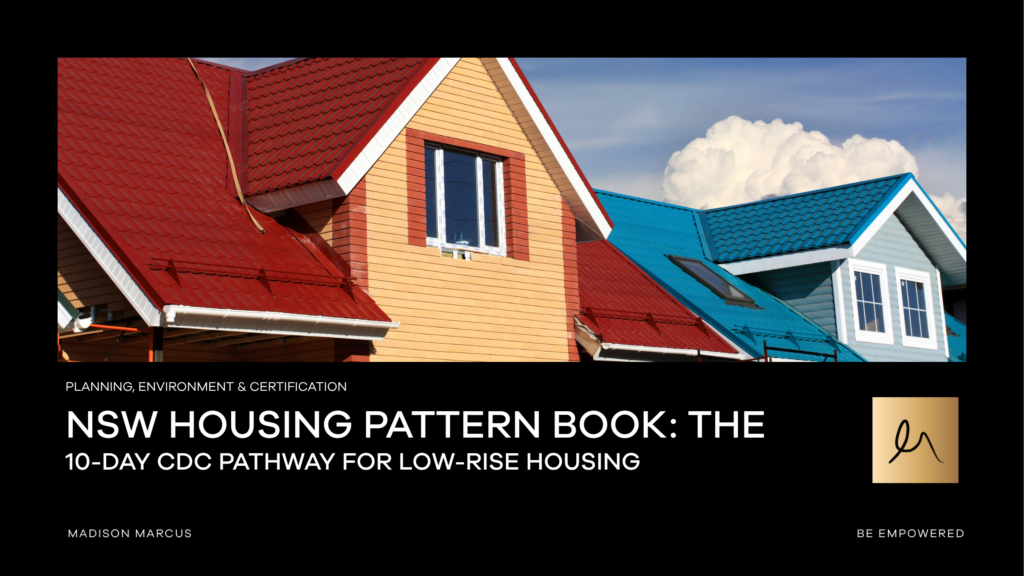
The NSW Housing Pattern Book has introduced a new pathway for eligible low-rise residential development, allowing certain projects using approved Pattern Book designs to obtain a Complying Development Certificate (CDC) in as little as 10 days.
Introduced in July 2025, the Pattern Book forms part of the NSW Government’s broader program of planning reforms aimed at accelerating housing delivery and increasing the supply of well-designed low and mid-rise housing.
More than a year after its introduction, there are now early signs of the pathway being put into practice. As at July 2026, 38 CDC applications had been lodged using low-rise Pattern Book designs and 21 CDCs had been issued.
For developers and landowners considering terraces, dual occupancies, manor houses and other eligible low-rise development, the pathway creates an additional option that should be considered when determining the most appropriate approval strategy for a site.
What is the NSW Housing Pattern Book?
The NSW Housing Pattern Book is a collection of architect-designed housing patterns developed by Government Architect NSW.
The designs are intended to provide adaptable housing solutions that can be used on suitable sites across NSW. The Pattern Book encompasses both low-rise and mid-rise housing, although the planning pathways available to each differ.
Importantly, using a Pattern Book design does not automatically mean a development can proceed as complying development.
For low-rise development, eligibility for the accelerated CDC pathway depends on the development being permissible with consent, the site satisfying the relevant eligibility requirements and exclusions, and the proposal complying with the applicable Pattern Book requirements and development standards.
A New Complying Development Pathway
The Pattern Book Development Code is contained in Part 3BA of the State Environmental Planning Policy (Exempt and Complying Development Codes) 2008 (Codes SEPP). It establishes a specific complying development pathway for eligible low-rise Pattern Book projects.
The distinction is significant.
A standard development application involves merit assessment by the relevant consent authority. Complying development instead provides a combined planning and construction approval process where predetermined development standards are satisfied.
The NSW Government states that standard complying development approvals can be issued in as little as 20 days. For eligible Housing Pattern Book development, that period can be reduced to as little as 10 days.
The Pattern Book pathway also reduces the required pre-approval neighbour notification period from 14 days under the usual complying development process to seven days.
For projects capable of satisfying the requirements, this can materially reduce the planning approval period compared with proceeding through a conventional development application.
Is Every Site Eligible?
No.
The availability of a Pattern Book design should not be confused with eligibility for the Pattern Book complying development pathway.
The general complying development requirements and exclusions under Part 1 of the Codes SEPP continue to apply. Part 3BA also contains additional exclusions specifically applicable to Pattern Book development.
For example, the pathway does not apply to certain land affected by environmental, heritage or hazard constraints. Additional exclusions under the Pattern Book Development Code include bush fire prone land, flood control lots, battle-axe lots, unsewered land and land identified as susceptible to landslide risk.
Site-specific investigations therefore remain important before a developer commits to the CDC pathway.
A proposal must also comply with the applicable development standards and maintain the integrity of the selected Pattern Book design within the permitted adaptations.
Design Verification Is Required
The accelerated pathway does not remove the need for professional design and certification input.
An application for a Pattern Book CDC must include a Design Verification Statement prepared by an appropriately accredited designer.
The statement confirms matters including the Pattern Book design being used and that the proposed development maintains the design integrity of that pattern.
Pattern Book designs can be adapted, but only within the parameters permitted for the particular pattern. Changes falling outside those parameters may mean the project can no longer rely upon the Pattern Book complying development pathway.
This makes early coordination between the developer, designer, planner, certifier and legal advisers particularly important.
How Much Has the Pathway Been Used?
The first detailed figures provide an indication of how the new pathway is being adopted.
In response to a question on notice (No. 7932), answered on 9 July 2026, the Minister for Planning and Public Spaces advised that 24,974 Pattern Book designs had been purchased since the program’s launch.
During that period, 38 complying development applications had been lodged using low-rise patterns and 21 CDCs had been issued.
Those certificates were issued across nine local government areas, with the greatest number in Sutherland Shire, where seven CDCs had been issued, followed by Georges River with four and The Hills Shire with three.
The Department was also aware of nine approved Pattern Book projects that had commenced construction.
The figures suggest considerable interest in the designs themselves, although the number of projects progressing through the Pattern Book CDC pathway remains comparatively modest at this early stage.
They also demonstrate that the pathway is operational rather than merely theoretical, with certificates now issued across a range of metropolitan and regional council areas.
CDC or DA: Which Pathway Is Right for a Project?
The 10-day timeframe is attractive, but speed should not be the only consideration when determining an approval strategy.
For a suitable site and a development that can comfortably operate within the Pattern Book requirements, the CDC pathway can provide greater certainty and significantly shorter assessment periods.
A conventional DA may remain more appropriate where a site is excluded from complying development, where the proposed design requires substantial modification, where the site is burdened by a restriction of use limiting development or where achieving the project’s commercial objectives requires flexibility beyond the Pattern Book development standards.
The question for developers is therefore not simply whether a Pattern Book design is available, but whether using that design and complying with the associated controls produces the best planning and commercial outcome for the particular site.
How Madison Marcus Can Assist
Madison Marcus’ Planning, Environment & Certification team advises developers, landowners, builders and other project participants on planning approval and building certification pathways across NSW.
Our team can assist with assessing eligibility for the Pattern Book Development Code, interpreting the Codes SEPP and applicable development standards, identifying site constraints and determining whether a CDC or development application provides the more appropriate pathway for a proposed development.
Early advice can be particularly valuable before committing to a Pattern Book design or approval strategy, allowing potential eligibility and certification issues to be identified before significant time and cost are incurred.
If you are considering a low-rise residential development and would like advice on whether the NSW Housing Pattern Book complying development pathway is available for your site, contact Madison Marcus’ Planning, Environment & Certification team.