

Introduction
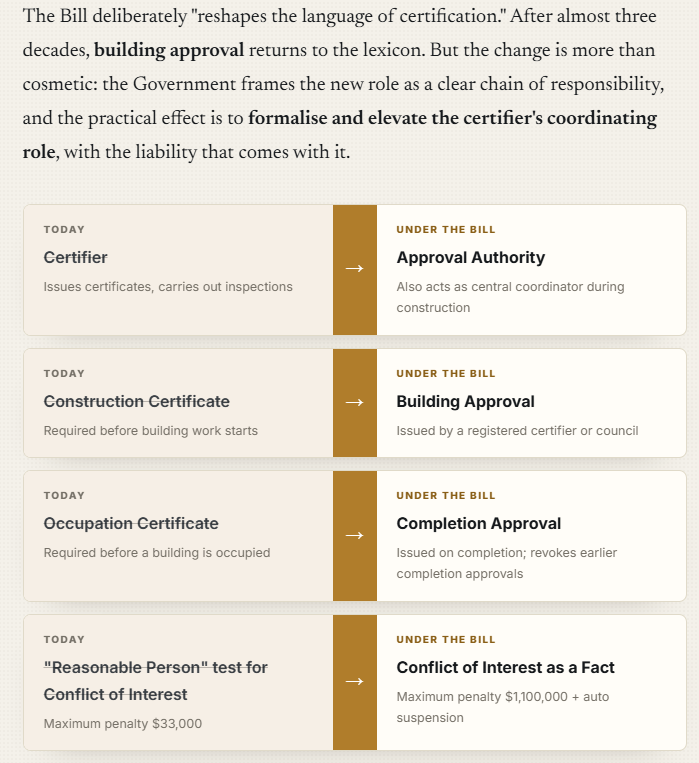
The NSW Government is rewriting the law applying to the certification of building work. The government introduced the Building (Approvals and Practitioners) Bill 2026 (“The Bill”) into NSW Parliament on 6 May 2026. However, it will not commence until the regulations are drafted. It repeals the Building and Development Certifiers Act 2018 (‘BDC Act’) in its entirety.
This article explains how the conflict of interest provisions change from the current BDC Act to the Bill. It also sets out what those changes mean for certifiers and for directors of certification firms.
Where the Law Stands Today
Under the current BDC Act, a registered certifier must not carry out certification work where they hold a conflict of interest (section 28(1)). However, exempt conflicts fall outside this prohibition. The maximum penalty for a contravention of the provision is 300 penalty units or $33,000 for an individual.
The overriding test for conflict of interest under the current BDC Act is the “reasonable person” test. A conflict of interest exists if a reasonable person would conclude that the certifier holds a private interest. That interest must conflict with, and may affect, the certifier’s duty to act in the public interest.
Section 29(2) of the BDC Act defines the circumstances in which a certifier has a private interest. Those circumstances include:
- obtaining the benefit of the work;
- holding a pecuniary interest;
- prior professional services on the design or development application; and
- family, personal, employment or business relationships with any such person
Sections 24 and 25 of the Building and Development Certifiers Regulation 2020 (NSW) add prescribed scenarios and exemptions.
What Is Changing?
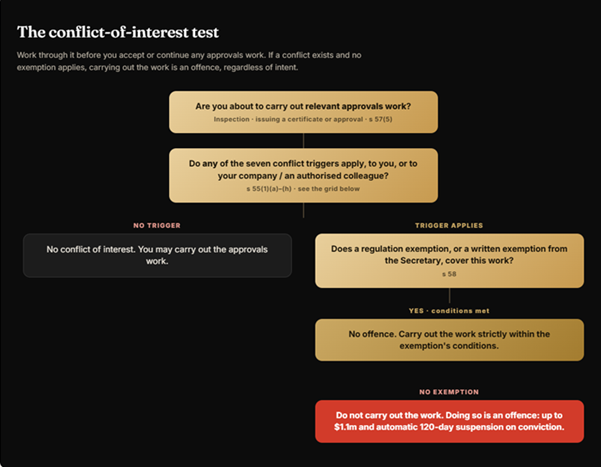
The Bill deals with conflicts of interest in Division 3 of Part 5 (sections 55 to 58). The most significant structural change is the move to an objective test for the existence of a conflict of interest. The reasonable person test disappears entirely. This changes how assessors approach the question. They no longer assess the conflict from a reasonable person’s perspective. Instead, the facts giving rise to the private interest decide it. Once the facts establish a private interest, the conflict follows automatically.
The following chart will assist practitioners to navigate the new provisions:
The Deemed Conflict Categories
The Bill replaces “certification work” with “approvals work”. Under section 55(1), a person carrying out approvals work is deemed to have a conflict of interest if they fall into any of the following categories:
- a person who obtains the benefit of the approvals work;
- a person who has been involved in the construction or design of an aspect of the development or building to which the approvals work relates;
- a close associate of the person for whom the approvals work is being carried out;
- for approvals work carried out in a local government area other than for the local council: a councillor or employee of that council;
- a person with a pecuniary interest in the development or building;
- for strata certification work: the person who prepared the strata plan of subdivision, notice of conversion or plan for the strata certificate;
- a person prescribed by the regulations; or
- a person with a family, personal, employment or business relationship with a person in categories (a) to (f).
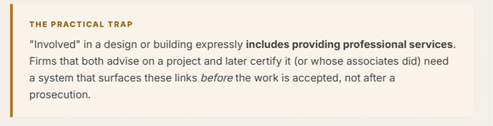
Here, “involved” extends to providing professional services, but excludes approvals work itself.
The regulations will exempt specified circumstances in which no conflict exists (clause 55(2)). Similarly, this mirrors section 25 of the current Regulation. However, government has not yet drafted those regulations.
Two New Concepts: ‘Involved’ and ‘Close Associate’
The Bill introduces the following new concepts:
- being “involved” in construction and design (defined in section 56(3) of The Bill); and
- a “close associate” of another person (defined in section 11 of The Bill)
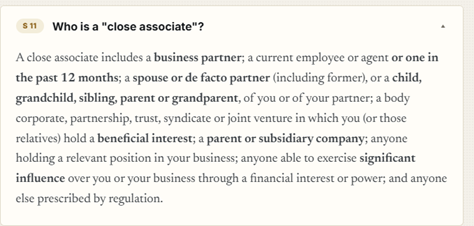
Critically, the definition of close associate operates on status, not knowledge. Importantly, a certifier does not need to know about a beneficial interest in order to contravene the conflict provisions. In particular, two features deserve attention:
- the 12-month employment lookback means a practitioner who recently left a developer’s employment remains that developer’s close associate for a year; and
- in corporate webs, “the person for whom the approvals work is being carried out” may itself need unpacking before the associate map can be drawn.
Section 11 defines close associate. Overlay that definition on paragraph 55(1)(h), and the scope of the certifier’s pecuniary interest in approvals work expands considerably. A pecuniary interest of a close associate of a family member, friend or employee of the certifier is deemed to be a pecuniary interest of the certifier.
How ‘Pecuniary Interest’ Changes
The scope of a “pecuniary interest” as currently defined in the BDC Act (section 30) changes under The Bill (section 56) as follows:
- Section 56 drops the words ‘or loss’ from the phrase “reasonable likelihood or expectation of appreciable financial gain or loss to the registered certifier” and
- ‘Close associate’ replaces the phrase “a person with whom the registered certifier has a relationship (whether family, personal, employment, or business)”.
Several observations follow about the pecuniary interest test in the Bill:
- the test is objective and prospective. In practice, the words “likelihood or expectation” bite before any money moves, so options, success fees and approval-conditional contracts qualify;
- a close associate’s gain also counts. The Bill attributes a spouse’s shareholding or a sibling’s subcontract whether or not the practitioner asked;
- the two exclusions do opposite jobs. For example, a remoteness carve-out reintroduces the evaluative judgment the list set out to remove; and
- by contrast, the fee carve-out concedes that payer-pays is a permanent, tolerated conflict; and
- importantly, the Bill deems a close associate’s interest to be an interest of the certifier.
Director’s Liability
Section 57(2) of The Bill extends liability to directors and employees in defined circumstances where the registered body corporate, or an authorised colleague, holds the conflict. Combined with section 55(1)(h), conflicts travel through organisations in both directions, the entity contaminated by an individual, the individual exposed by the entity. Section 57 of The Bill makes the conflict an enterprise risk, and the probability that a certifier has a pecuniary interest increases with headcount in large certification firms. As mentioned, the maximum penalty for contravening the conflict of interest provisions is $1,100,000.
Sections 189(1) also deems a director of a registered body corporate liable for the body corporate’s contravention. However, this applies only in certain circumstances. In addition, section 120(1) imposes a mandatory reporting obligation on directors of a registered body corporate. Specifically, they must report conflict of interest breaches by the body corporate, by another director or by a registered individual. The maximum penalty for contravening sections 120 and 189 is $33,000 and $1,100,000 (for a conflict of interest contravention).


Michael Mantei: Partner, Planning, Environment & Certification
Michael Mantei is the Head of Madison Marcus’ Planning, Environment & Certification Division and an Accredited Specialist in Local Government and Planning Law. With more than 20 years of experience and a background in local government planning, he advises clients on planning, environmental, certification and development matters. Michael is recognised for delivering practical, commercially focused solutions across complex regulatory and dispute matters.

Paul Vergotis: Partner, Planning, Environment & Certification
Paul is an Accredited Specialist in Planning & Environment Law and Partner at Madison Marcus, with over 30 years’ experience across legal practice and town planning. He is a leading adviser on development, regulatory approvals and Land and Environment Court litigation, known for delivering practical, commercially focused outcomes on complex planning and infrastructure matters.