

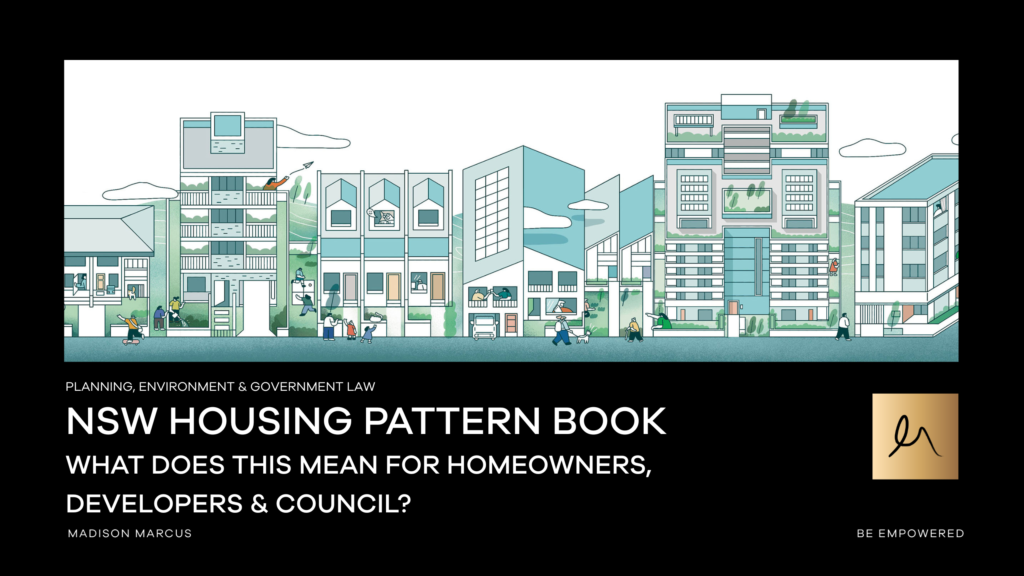
The NSW Housing Pattern Book (Pattern Book) commenced on 30 July 2025 following amendments to the Environmental Planning and Assessment Regulation 2021 (EPA Reg) and State Environmental Planning Policy (Exempt and Complying Codes) 2009 (Codes SEPP). The NSW Government introduced the Pattern Book as part of a broader policy response to housing supply and affordability across New South Wales.
The reforms establish a new complying development pathway for low and mid-rise housing types. They also introduce new design, eligibility and assessment requirements that apply to homeowners, developers, certifiers and councils.
Overview of the NSW Housing Pattern Book
The Pattern Book provides a series of pre-approved housing designs intended to streamline approval pathways for selected residential development. The framework enables applicants to rely on standardised designs that meet prescribed planning, design and technical requirements.
The NSW Government intends the Pattern Book to reduce assessment timeframes and increase certainty for low and mid-rise housing delivery. The system does not apply universally. It only operates where zoning, land use and site-specific criteria permit development under the Codes SEPP.
What is the Pattern Book?
The NSW Government Architect has approved eight (8) designs for dual occupancy, terraces, townhouses and manor houses that qualify for a simplified complying development certificate (CDC) approval pathway. Applicants can purchase the designs from the NSW Government, initially for A$1.00 per design and then for A$1,000.00 per design.
The NSW Government Architect, Abbie Galvin, commented on the release of the designs, stating:
The initiative aims to deliver housing quickly and consistently while streamlining both the planning approval process and construction outcomes.
By streamlining approval processes and offering pre-designed templates, the policy seeks to encourage landowners to redevelop by simplifying approval processes and reducing expenses i.e. upfront costs. Alongside the pre-approved designs, the NSW Government has also introduced a new ten (10) day approval pathway to fast-track eligible developments. The NSW Minister for Planning and Public Spaces, Paul Scully, stated:
New Complying Development Pathway
The Codes SEPP implements the Pattern Book designs under the complying development framework in a new Part 3BA. The complying development pathway, and the resulting complying development certificate (CDC), provides an alternative approval process to lodging a development application with the local council. An accredited certifier issues a CDC.
If you are a homeowner or developer with land in a residential zone, you may be able to fast-track approval for your project through complying development. This applies where the design follows the Pattern Book requirements and relevant location requirements and development standards.
The new Part 3BA of the Codes SEPP allows dual occupancies, manor housing, multi-dwelling housing, row housing or terrace housing to be approved by a CDC in the following circumstances:
-
On a lot in zone R1 General Residential, R2 Low Density Residential and R3 Medium Density Residential (see Code 3BA.3(1));
-
If the design is in accordance with a Pattern Book (see Code 3BA.3(2)–(6));
-
On a lot that satisfies the minimum lot size allowed for that type of development, other than land classified within the Low and Mid Rise Housing Areas under Chapter 6 of the State Environmental Planning Policy (Housing) 2021 (Housing SEPP)(see Code 3BA.3(7)–(9));
-
On a lot that has lawful access to a public road (see Code 3BA.3(7)(b));
-
Not on bushfire prone land, flood affected land, unsewered land, battle-axe lots, or land within heritage, coastal hazard or foreshore areas (see Code 3BA.6–3BA.7);
-
Where the design complies with detailed construction specifications for earthworks, retaining walls, drainage and setbacks (see Code 3BA.8–3BA.12).
The new Part 3BA of the Codes SEPP also permits both Torrens title and strata subdivision for projects involving dual occupancies and multi-dwelling housing. This applies where the subdivision and the building work form part of a single Complying Development Certificate (CDC) (see Code 3BA.4–3BA.5).
Applications for a CDC Pattern Book Development
New Statutory Requirements for CDC Applications
The Pattern Book scheme is accompanied by the introduction of sections 131A, 133(2) and 134(3A) into the Environmental Planning and Assessment Regulation 2021. These new provisions require the following:
-
An application for a CDC under Part 3BA of the Codes SEPP must be accompanied by a written statement from an accredited designer. The statement must identify the type of development and the Pattern Book design selected. It must also confirm that the proposed development will comply with the applicable development standards, location requirements, technical drawing set and information specified in the pattern (see s 131A).
-
A certifier must determine an application for a CDC relating to development specified in Part 3BA of the Codes SEPP within ten (10) days (see s 133(2)).
-
A certifier must not issue a CDC until at least seven (7) days after giving written notice to each neighbour on land in a residential zone, where applicable, and to the relevant council (see s 134(3A)).
Download the summary paper ‘EP & A Act – Summary of Amendments LN’ below:
Determination Timeframes & Compliance Considerations
These amendments aim to simplify the CDC process. They make it easier and more efficient for certifiers to assess applications and more attractive for homeowners and developers. However, the framework also imposes tighter time constraints on certifiers.
In The Hills Shire Council v Drenovac (2022), the Land and Environment Court of NSW held that the validity of a CDC can only be questioned in very limited circumstances once three (3) months has elapsed from the date of issue. Within that three (3) month period, the Court may undertake its own assessment of the development against the relevant development standards.
The decision highlights the importance of strict compliance with design standards and approval procedures. This is particularly the case under fast-tracked frameworks such as the Pattern Book. For councils, the case underscores the need to act promptly if they intend to challenge the validity of a CDC. As Pattern Book developments increase, legal scrutiny of CDC decisions may also increase.
Broader Implications of the Pattern Book Framework
In summary, the introduction of the Pattern Book aims to improve access to affordable and sustainable housing designs. It seeks to do this by incrementally increasing density in existing urban areas. It remains to be seen whether the NSW housing market will embrace Pattern Book designs and the new CDC approval pathway.
To view the pre-approved Pattern Designs, you can access the following link: Pattern Designs | Planning
Further Information & Legal Advice
For further information about the NSW Housing Pattern Book, or if you require legal advice in relation to planning controls, CDC applications or certification obligations, please contact Michael Mantei or Paul Vergotis. Contact us today.