

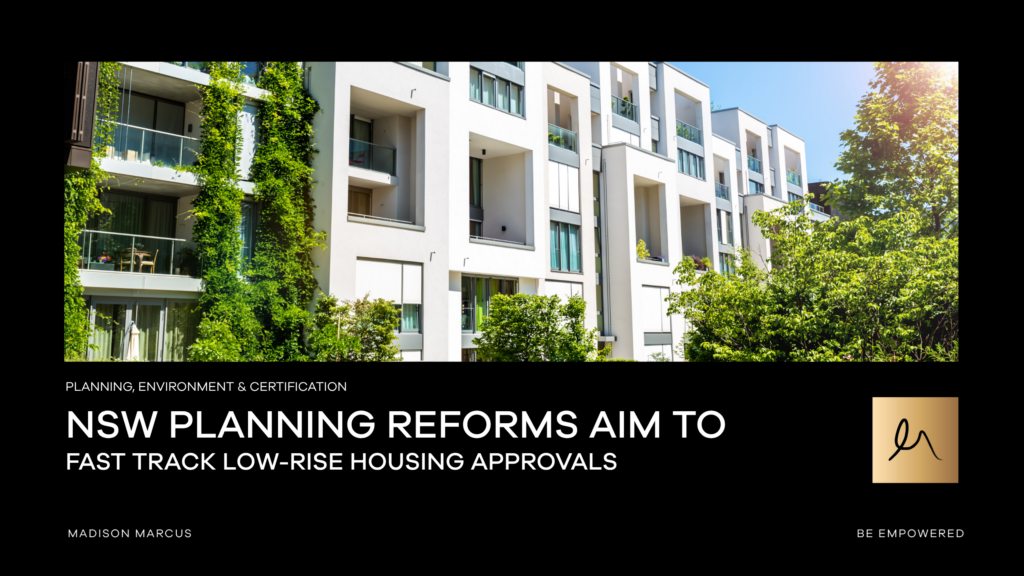
The NSW Department of Planning, Housing and Infrastructure has announced the next tranche of new planning reforms originally passed by Parliament in November 2025. This component of the reforms will provide flexibility to certifiers when assessing proposals that involve a minor departure from a development standard. The underlying purpose of the change is to enable building low-rise housing such as single dwellings, duplexes and townhouses faster and easier.
The reforms form part of the Minns Government’s broader housing delivery agenda and are intended to reduce delays in the planning system, increase housing supply and simplify approval pathways for developments that meet planning requirements.
For developers, builders, landowners and property investors, the changes may create significant opportunities to reduce approval timeframes and bring projects to market sooner.
What Is Changing?
The reforms introduce two new planning pathways that are intended to streamline approvals for low-rise residential developments, which currently account for around 70% of all development applications (DAs) in NSW.
-
Expanded Complying Development Pathway
The first component of the reforms applies to the extended complying development certificate (“CDC”) pathway. Madison Marcus first published on this pathway in our article dated 5 February 2026. The new provisions (section 4.31A of the Environmental Planning and Assessment Act 1979) allows an applicant for a CDC or modification of an existing CDC to apply to an “appropriate person” (which is proposed to be the council of the area) to vary a complying development standard applying to the proposed building.
The Department of Planning, Housing and Infrastructure has now release explanation of intended effect (“EIE”) outlining the detailed planning system changes necessary to facilitate the “CDC variation process” under section 4.31A of the Act. The EIE is currently on public exhibition.
In summary, the new CDC variation process will enable a council to approve variations to specified complying development standards through the issue of a “variation certificate”. Once a variation certificate is issued, the other components of the CDC application can continue to be considered by a registered certifier or by council.
These reforms expand the complying development framework to allow certain low-risk developments with minor non-compliances to still proceed through the CDC assessment process. Under the proposal, the Department anticipates approval timeframes for these development could reduce from an average of approximately 80 days to around 20 days.
The CDC variation process is expected to benefit projects that generally comply with planning controls but may previously have required a full DA process due to relatively minor variations.
-
Targeted Assessment Pathway
The second reform introduces a new targeted assessment pathway for low-rise housing developments that do not qualify as complying development but still meet broader strategic planning objectives. The Department has recently released a discussion paper on this topic inviting submissions.
The “targeted assessment pathway” is proposed to apply to developments such as:
- Single dwellings
- Dual occupancies
- Terraces
- Townhouses
- Low-rise residential projects
The Department describes the targeted assessment as a “flexible, streamlined pathway for development that is low-impact, low-risk or has undergone detailed assessment at a strategic level”. The new targeted assessment pathway is given legislative effect by sections 4.15(1C) and (1D) of the Environmental Planning and Assessment Act 1979 passed in November 2025 which “switch off” certain matters for consideration of a development application in section 4.15(1) of the Act. “Residual” assessment matters will continue to be captured in detailed controls and specific merit considerations that apply to the development.
The Department anticipates that assessment timeframes for targeted development will reduce from approximately 115 days to around 50 days.
Why These Reforms Matter
The NSW Government has repeatedly identified planning delays as a key obstacle to housing delivery, particularly as the state works towards ambitious housing supply targets.
For the development industry, delays in approvals can significantly impact:
- Project feasibility
- Construction costs
- Finance arrangements
- Holding costs
- Market timing
- Housing affordability outcomes
The reforms are also closely tied to broader planning system changes and proposed building productivity reforms that seek to modernise approvals and support modular and prefabricated construction methods.
Potential Opportunities for Developers and Landowners
If implemented as proposed, the reforms may provide opportunities for:
Faster Project Delivery
Reduced approval timeframes may allow developers to commence projects sooner and improve certainty around delivery programs.
Reduced Planning Risk
Clearer and more consistent pathways may assist in reducing uncertainty associated with minor planning variations and administrative delays.
Increased Feasibility for Low-Rise Housing
The reforms may improve the viability of smaller and medium-density housing projects, particularly in areas targeted for housing growth.
Greater Flexibility in Design and Construction
The NSW Government is also moving towards reforms supporting prefabricated and modular construction, which could further reduce costs and construction timeframes. (NSW Government)
Important Considerations
While the reforms are intended to simplify the planning process, developers and property owners should still carefully assess:
- Applicable zoning and planning controls
- State Environmental Planning Policies (SEPPs)
- Site-specific constraints
- Biodiversity and environmental considerations
- Infrastructure requirements
- Certification and construction obligations
- Whether a project genuinely qualifies for streamlined pathways
Importantly, faster pathways do not remove the need for compliance with applicable planning and building requirements.
How Madison Marcus Can Assist
The planning reforms represent another significant shift in the NSW development landscape.
Madison Marcus Planning, Environment & Certification Team advises developers, landowners, investors and consultants on:
- Development applications and planning approvals
- Complying development pathways
- Planning due diligence
- Strategic planning advice
- Land and Environment Court proceedings
- State significant development
- Certification and regulatory issues
- Infrastructure and development constraints
As the reforms progress through consultation and implementation, understanding how the new pathways apply to your project may be critical to maximising development opportunities and reducing approval risk.
Read the NSW Government Announcement here.

Michael Mantei: Partner, Planning, Environment & Certification
Michael Mantei is the Head of Madison Marcus’ Planning, Environment & Certification Division and an Accredited Specialist in Local Government and Planning Law. With more than 20 years of experience and a background in local government planning, he advises clients on planning, environmental, certification and development matters. Michael is recognised for delivering practical, commercially focused solutions across complex regulatory and dispute matters.

Paul Vergotis: Partner, Planning, Environment & Certification
Paul is an Accredited Specialist in Planning & Environment Law and Partner at Madison Marcus, with over 30 years’ experience across legal practice and town planning. He is a leading adviser on development, regulatory approvals and Land and Environment Court litigation, known for delivering practical, commercially focused outcomes on complex planning and infrastructure matters.