
By Gorkem Oksuz and Brad Marland
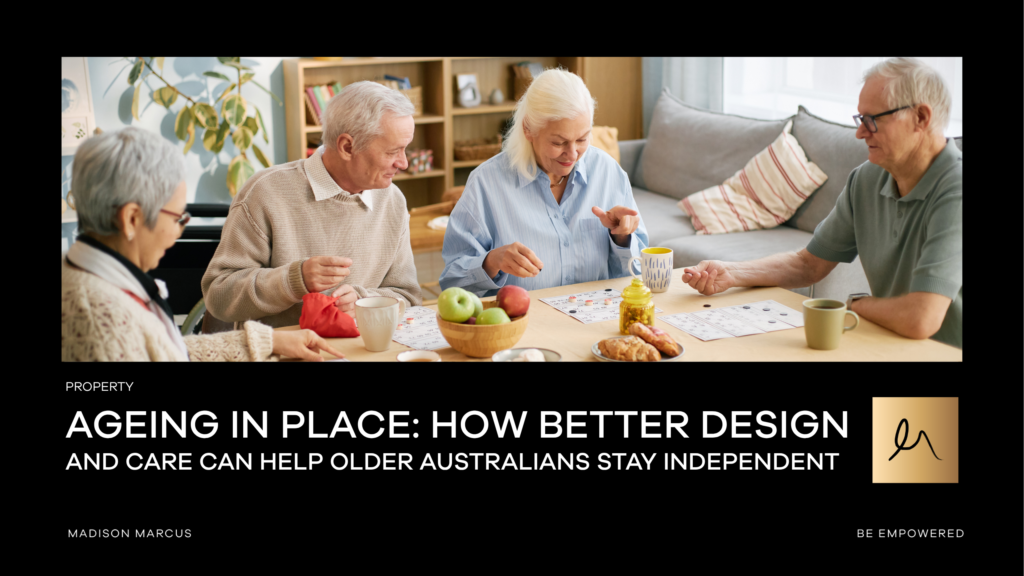
Ageing in place is becoming central to how Australians think about housing, retirement living and aged care. But what does it actually involve and when does it work best?
| IN SUMMARY – Ageing in place is not simply about remaining in the same house. It is about enabling an older person to live in a home and community of their choice, with housing, care and support that adapt as their needs change. |
For many Australians, home represents far more than accommodation. It provides familiarity, independence, identity and connection to family and community. It is therefore unsurprising that many older people want to remain at home for as long as possible.
Ageing in place seeks to make that possible. The model combines suitable housing, accessible surroundings, social connection, assistive technology and responsive health and aged-care services. It does not mean remaining at home at all costs. The aim is to preserve choice and independence for as long as the arrangement remains safe, practical and wanted.
Why home design matters
A recent ABC Radio National discussion with UTS Professor Phillippa Carnemolla highlighted that good design can operate as a form of care. A level entrance, safer bathroom, improved lighting, a usable kitchen and space for mobility equipment can change whether an older person needs help with ordinary daily activities.
Australian research involving 157 community-care recipients found that home modifications were associated with a 42% reduction in weekly care hours, with the greatest reduction occurring in informal care. The result will not be the same for every household, but it demonstrates an important point that the physical environment can either support independence or create avoidable dependence.
The main advantages of ageing in place
- Independence and control: older people can retain familiar routines and make ordinary decisions about their home, visitors and daily life.
- Continuity and wellbeing: familiar surroundings, possessions and community connections can support confidence, identity and emotional security.
- Safer daily living: appropriate modifications and assistive products may reduce hazards and make personal care safer for older people and carers.
- Support for families: a suitable home and reliable formal services can reduce the amount of physical assistance and coordination expected of relatives.
Where the PACE model fits
PACE, the Program of All-Inclusive Care for the Elderly, is a United States model for certain older people who meet a nursing-home level of care but can still live safely in the community. It brings medical care, rehabilitation, home support, transport and social services together through one interdisciplinary team and coordinated care plan.
| IMPORTANT DISTINCTION – PACE is not an Australian aged-care program. Its eligibility, funding and regulation are specific to the United States. Its relevance in Australia is as an example of how integrated care can reduce gaps between health, home support and social services. |
The useful lesson from PACE, is that ageing in place works best when someone sees the whole person. Housing, mobility, medication, personal care, transport and social isolation are connected issues. A single care plan, clear responsibility and regular reassessment can be more effective than a series of disconnected services.
How retirement villages can support ageing in place
Retirement villages can provide an effective middle setting between a dispersed family home and residential aged care. Residents retain a private home while gaining access to purpose-designed housing, nearby neighbours, communal activities and, in some villages, emergency response or visiting care services.
A village may also make services easier to organise because home-care workers, allied-health practitioners and transport providers can assist several residents in one location. This can support earlier planning and more gradual increases in care.
However, a retirement village is not automatically an aged-care service or residential aged-care home. The village operator, home-care provider and residential-care provider may be separate organisations. Prospective residents and families should understand who provides each service, what it costs, what happens if care needs increase and whether any promise of continuing care is reflected in the actual arrangements.
How it connects with Australian aged care
Australia’s Support at Home program provides government-funded aged-care services intended to help eligible older people remain independent and healthy at home. Depending on assessment and program rules, support may include clinical care, personal care, domestic assistance, allied health, assistive technology, home modifications, restorative care and end-of-life care.
Residential aged care remains an essential part of the continuum. It may become the safer option where care needs are continuous or complex, a home cannot be adapted, suitable services are unavailable, or family carers can no longer sustain the role. Moving into residential care should not be treated as a failure of ageing in place; the objective is always the right setting with the right support.
Important considerations before deciding
- Is remaining at home the older person’s informed preference?
- Can the dwelling be adapted safely and affordably?
- Are suitable services available locally, including after-hours assistance?
- Is the arrangement sustainable for family and other informal carers?
- Are privacy, consent and cybersecurity addressed if monitoring technology is used?
- Is there a plan for emergencies, respite and future transitions?
| THE CENTRAL PRINCIPLE Ageing in place should expand an older person’s choices, not create pressure to remain at home when the arrangement is unsafe, isolating or no longer appropriate. |
How we can assist
The legal arrangements surrounding ageing in place can involve property ownership, retirement-village contracts, home modifications, service agreements, enduring powers of attorney and future-care planning. Clear advice at the outset can help older people and their families understand their options, responsibilities and costs, before making a significant housing or care decision.
Our team can assist individuals, families, retirement-village residents and operators with the legal aspects of retirement living, aged care, property and estate planning. For advice tailored to your circumstances, please contact us.
This article provides general information only and is not legal, financial or clinical advice. Individual circumstances and program settings should be checked before acting.

Brad Marland: Partner, Real Estate & Development
Brad Marland is a Partner in Madison Marcus’ Real Estate & Development Division, with nearly 25 years of experience across the Australian property sector. He advises major public companies, developers, landlords, tenants, local governments and authorities on complex property transactions, leasing, acquisitions and disposals, joint ventures and licensing. Brad is known for his practical, no-nonsense approach and delivering fast, reliable and commercially focused advice.