
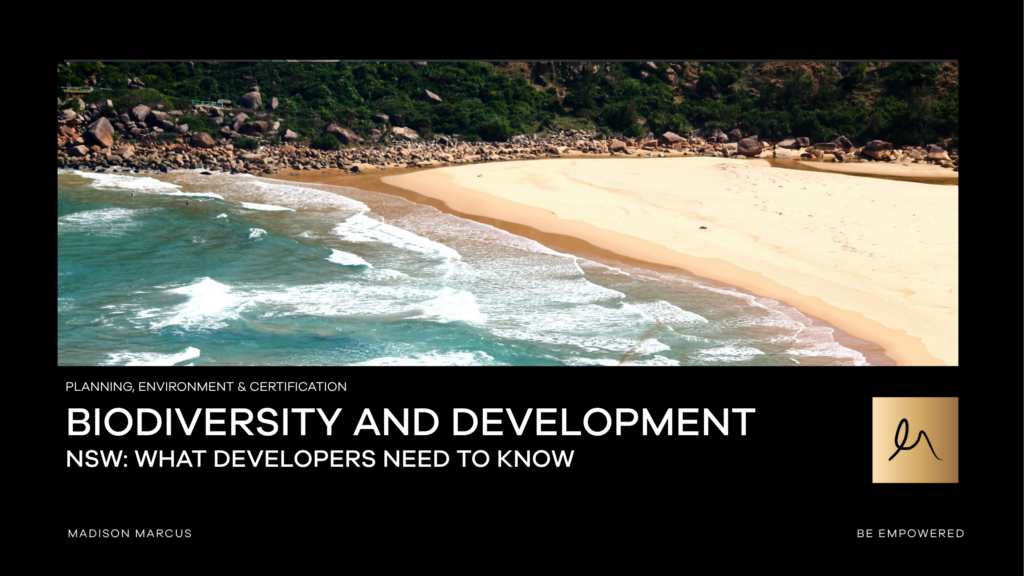
Madison Marcus recently partnered with the Property Council of Australia Member Briefing and MMJ Wollongong to deliver a presentation on one of the most complex and evolving areas of New South Wales planning law: biodiversity and development.
The session brought together developers, planners and industry professionals and focused on how biodiversity constraints on development, statutory frameworks and recent court decisions are shaping development outcomes across NSW, particularly in the Illawarra–Shoalhaven region.
Drawing on insights from Lucas McKinnon ecologist, Lauren Turner town planner and Michael Mantei and Paul Vergotis from the Madison Marcus Planning, Environment & Certification team. The following article outlines the key legal and strategic takeaways for developers navigating biodiversity risk.
Why Biodiversity Is Now Central to Development Strategy
Biodiversity is no longer a secondary planning consideration. It is a primary constraint that can determine whether a project proceeds at all.
As highlighted during the briefing, biodiversity considerations often intersect with:
- Flooding and riparian corridors
- Bushfire risk and asset protection zones
- Threatened species and ecological communities
- Coastal and vegetation mapping layers
Early-stage planning is critical. Once a concept design is advanced without accounting for biodiversity constraints, the ability to adjust becomes limited, costly and, in some cases, fatal to the project.
As noted in the session, constraint mapping should occur before:
- Lot yield assumptions are finalised
- Planning pathways are selected (DA, CDC or Planning Proposal)
- Any removal of native vegetation is contemplated
The Biodiversity Conservation Act and the “Avoid, Minimise, Offset” Hierarchy
At the centre of biodiversity regulation in NSW is the Biodiversity Conservation Act 2016 (NSW)¹.
A critical concept under this framework is the “avoid, minimise, offset” hierarchy, which governs how biodiversity impacts must be assessed and justified.
The hierarchy is not optional. It operates sequentially:
- Avoid impacts wherever possible
- Minimise impacts that cannot be avoided
- Offset residual impacts through biodiversity credits or payments
A key takeaway from the briefing is that this is not a box-ticking exercise. Courts are increasingly scrutinising whether proponents have genuinely followed this sequence.
Lessons from Recent Land and Environment Court Decisions
Recent decisions of the NSW Land and Environment Court demonstrate how strictly biodiversity obligations are being applied in practice.
GTH Resorts v Ballina Shire Council²
This case confirmed that:
- Avoidance and minimisation are distinct and sequential steps
- There is no minimum threshold of avoidance before minimisation begins
- Each proposal will be assessed on its specific facts and design response
The Court accepted that a properly structured BDAR (Biodiversity Development Assessment Report) can demonstrate compliance where impacts are clearly quantified and addressed.
Surewin Parkview Pty Ltd v Wollongong City Council³
This decision highlights a critical risk for developers:
- Biodiversity impacts cannot be traded off against bushfire safety outcomes
- Performance-based solutions will not be accepted where they undermine statutory protections
The Court ultimately refused the development application, reinforcing that compliance with Planning for Bushfire Protection (PBP) cannot be compromised to accommodate biodiversity impacts.
Sentros Pty Ltd v Central Coast Council⁴
This case clarified the interaction between biodiversity law and broader planning legislation:
- The Biodiversity Conservation Act can prevail over the Environmental Planning and Assessment Act 1979 (NSW) where inconsistencies arise
- Consent authorities must consider biodiversity impacts through the BDAR
- Residential zoning does not guarantee development approval
The key commercial takeaway is clear: zoning is only one part of the equation.
Northern Beaches Council v Vigor Master Pty Ltd⁵
In this important 2025 decision, the Court confirmed that:
- Biodiversity assessment is not limited to the BDAR alone
- Local Environmental Plan (LEP) biodiversity clauses still have operative effect
- Decision-makers can consider biodiversity impacts under multiple statutory pathways
This reinforces a growing trend: layered regulatory assessment, where multiple instruments operate together rather than in isolation.
Biodiversity Offsets and the Real Cost of Development
Where impacts cannot be avoided or minimised, developers must turn to biodiversity offsetting.
This typically involves:
- Purchasing biodiversity credits
- Making payments into the NSW Biodiversity Conservation Fund
Credit requirements vary depending on vegetation types and ecological value, with some plant community types attracting significant offset obligations.
From a commercial perspective, this creates:
- Material cost exposure
- Feasibility risks
- Timing delays in approvals
Understanding offset liability early is critical to maintaining project viability.
Why Early Planning and Legal Strategy Matter
A consistent theme from the Property Council briefing was the importance of early, integrated advice.
Effective projects align:
- Ecological assessment
- Town planning strategy
- Legal risk management
From the outset.
As highlighted during the session, biodiversity constraints should inform design, not react to it.
Failing to do so can result in:
- Redesign costs
- Reduced yield
- Delayed approvals
- Refused development applications
How Madison Marcus Supports Developers
Madison Marcus works closely with developers, planners and consultants to navigate biodiversity and planning risk across NSW.
Our Planning, Environment & Certification team advises on:
- Biodiversity compliance under the Biodiversity Conservation Act
- Development applications and planning proposals
- BDAR strategy and legal risk positioning
- Land and Environment Court proceedings
- Strategic project structuring to manage biodiversity constraints
We focus on aligning legal, planning and commercial outcomes, ensuring projects are both approvable and viable.
Final Thoughts
Biodiversity is now one of the most decisive factors in development across New South Wales.
The regulatory framework is complex, the case law is evolving, and the consequences of getting it wrong are significant.
For developers, the message is clear:
Plan early. Assess properly. Design strategically.
¹ Environmental Planning and Assessment Act 1979 (NSW) https://legislation.nsw.gov.au/view/html/inforce/current/act-2016-063
² GTH Resorts No 10 Pty Ltd v Ballina Shire Council [2026] NSWLEC 1054 [NSW] https://www.caselaw.nsw.gov.au/decision/19c40839d4063a9c375fbb3e
³ NSW Department of Planning, Surewin Parkview Pty Ltd v Wollongong City Council https://apps.planningportal.nsw.gov.au/prweb/PRRestService/DocMgmt/v1/PublicDocuments/DATA-WORKATTACH-FILE%20PEC-DPE-EP-WORK%20PPSSTH-159!20241009T235720.372%20GMT
⁴ Sentros Pty Ltd v Central Coast Council [2024] NSWLEC https://www.caselaw.nsw.gov.au/decision/19cabd3d36b7b439ec3a5137
⁵ Northern Beaches Council v Vigor Master Pty Ltd [2025] NSWLEC 136 https://www.austlii.edu.au/cgi-bin/viewdoc/au/cases/nsw/NSWLEC/2025/136.html