

We are living through a structural shift in how societies organise information, value and decision‑making. History tends to label these moments only in hindsight. The printing press changed who could access knowledge. The internet reshaped how information moved, who could publish and how markets formed. Each transition brought extraordinary opportunity, alongside uncertainty, misuse and new forms of risk.
Today, we are in the middle of another such shift.
Artificial intelligence is becoming embedded across almost every industry, changing how work is performed and decisions are made. Blockchain, while more specialised, is quietly reshaping how trust, ownership and verification are established in digital systems. Together, these technologies are moving from novelty to infrastructure.
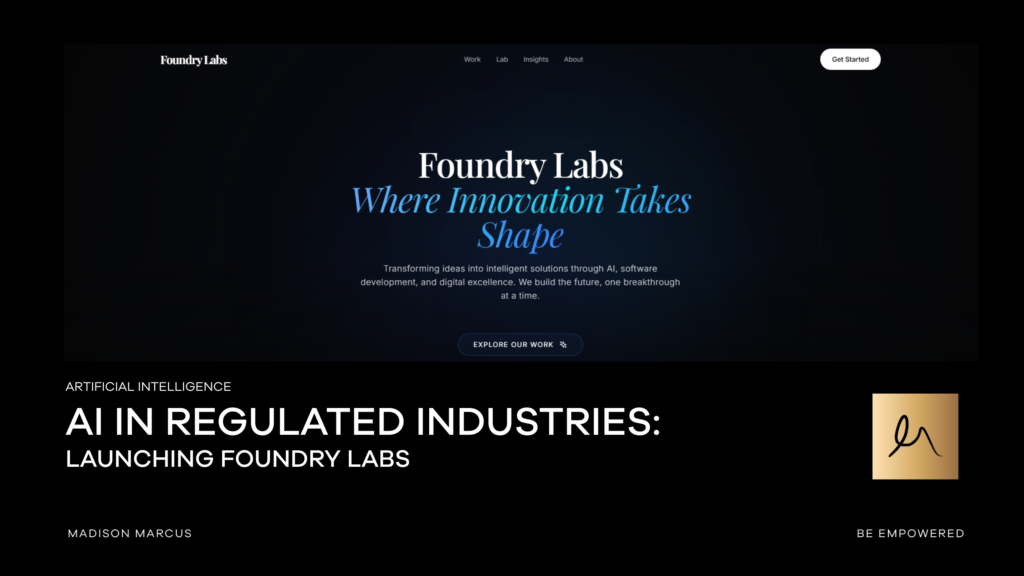
Foundry Labs was created in response to this moment.
It is a venture and systems studio focused on the pragmatic use of emerging technologies, artificial intelligence, data and blockchain, within regulated and high‑stakes environments.
Foundry Labs exists to help organisations navigate this transition deliberately, building systems that can operate in production, withstand regulatory and commercial scrutiny, and support real decision‑making once live, not just in theory.
When Innovation Becomes Infrastructure
As emerging technologies move from experimentation into everyday use, they stop behaving like optional tools and start acting as infrastructure. They shape workflows, incentives and outcomes at scale.
At this point, risk changes.
Automated and data-driven systems increasingly influence regulated outcomes across financial services, property, construction, healthcare and enterprise environments. Design decisions become accountability decisions. How systems are constrained, reviewed and governed defines how responsibility is assigned.
Automation does not remove legal or fiduciary obligations. Governance therefore cannot be bolted on after deployment. It must be embedded directly into system architecture, shaping how technology behaves in production.
Why Foundry Labs Exists
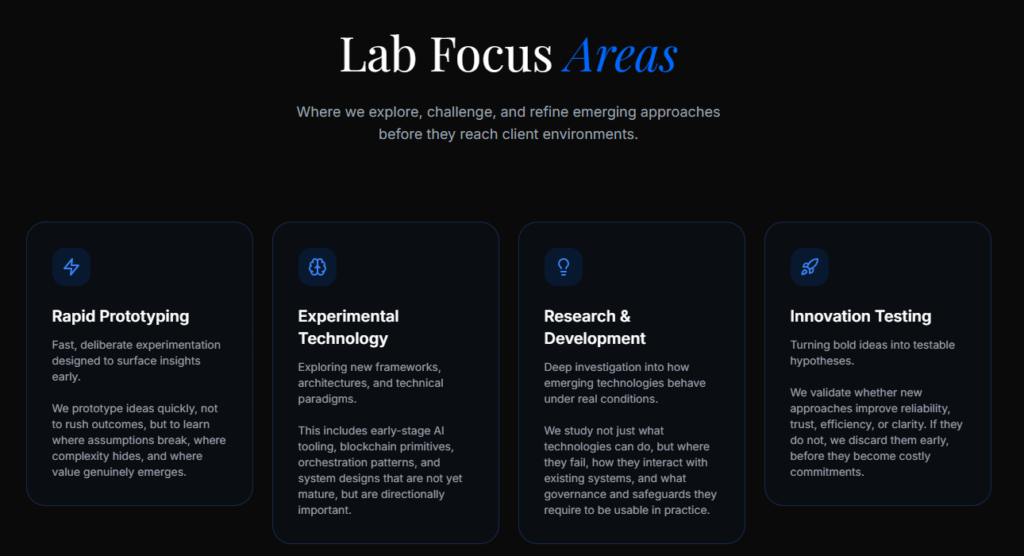
Foundry Labs was created specifically to operate in regulated environments where emerging technologies must function within real-world constraints.
Many innovation consultancies focus on experimentation, proofs of concept or conceptual strategy. While these approaches can generate ideas, they often fail when systems must transition into production, particularly where compliance, auditability and accountability are required.
Foundry Labs exists to bridge this gap. The team works where technology, regulation and commercial reality intersect, helping organisations move from ambition to execution without creating unmanaged risk.
Filling the Gap Between Legal Advice and Technical Execution
In regulated environments, legal advice and system design are often treated as separate workstreams. This disconnect can result in technology being deployed without a clear understanding of how legal obligations apply in practice.
Foundry Labs fills this gap by working alongside legal, compliance and executive teams to ensure that system behaviour aligns with governance frameworks and risk expectations. Rather than treating compliance as a retrospective exercise, regulatory considerations are embedded into how systems are built, operated and monitored.
Madison Marcus as a Core Partner
Madison Marcus is a core partner of Foundry Labs. As a law firm with deep experience advising clients on regulatory compliance, governance frameworks, risk allocation and legal exposure, Madison Marcus brings critical legal and regulatory insight into how Foundry Labs approaches system design and deployment.
This partnership ensures that legal considerations are not treated as an afterthought, but are engaged early, directly and practically in how technology systems are built and operated.
While Madison Marcus is a foundational partner, Foundry Labs also works across broader commercial, technical and institutional contexts. Its remit extends beyond legal services alone, supporting organisations, founders and enterprises navigating complex regulatory, operational and technological environments.
Together, Foundry Labs and Madison Marcus assist clients to:
- Assess legal and regulatory risk associated with AI and automated systems
- Design governance and accountability frameworks aligned with system behaviour
- Ensure technology architecture supports compliance obligations
- Make informed build‑versus‑buy decisions grounded in risk and operational reality
Supporting Clients as AI Moves into Production
As AI becomes embedded within core business operations, organisations can no longer rely on conceptual compliance models or high-level policy frameworks alone.
Effective legal and risk advice must reflect how systems operate in live environments, how decisions are made, how errors are surfaced, and how accountability is enforced.
Through this partnership, Madison Marcus expands its ability to support clients as AI, data and advanced systems move from experimentation into production.
Looking Ahead
The legal profession is increasingly required to engage with technology as a structural component of governance and risk management. AI and automation are now part of mainstream commercial decision-making.