

Not long ago, artificial intelligence was sold as a kind of corporate housekeeper. It would tidy the inbox, draft the memo, summarise the report, debug the code. The promise was gentle and appealing: less drudgery, more thinking. A liberation from the mundane.
Recently, Harvard Business Review published a piece titled AI Doesn’t Reduce Work — It Intensifies It¹. The research suggests that once organisations succeed in deploying AI tools, something unexpected happens. The work does not shrink. It swells. Expectations rise. Output accelerates. Review layers multiply.
The fantasy was subtraction.
The reality appears to be multiplication.
But even that framing is incomplete.
AI does not merely intensify work. It rearranges it.
The Vanishing Draft
Consider a common scenario inside a professional firm.
Before AI, drafting was the bottleneck. A memo might take hours. A research summary consumed an afternoon. The constraint was human speed, and that constraint created natural pacing.
Review was limited because output was scarce.
Then AI arrives.
The draft appears in minutes. The summary materialises almost instantly. The bottleneck dissolves.
But the work does not disappear. It migrates.
Now someone must:
-
-
Verify the sources.
-
Compare the output to primary documents.
-
Check for hallucinated citations.
-
Adjust tone and risk language.
-
Store the output in a knowledge system.
-
Determine whether it becomes precedent.
-
Drafting has collapsed in time.
Supervision has expanded in scope.
The labour has shifted from production to oversight.
And oversight, as it turns out, is heavier than it looks.
The Pressure of Compression
AI functions as a force multiplier. It compresses creation time. And compression changes pressure.
When something that once took three hours now takes twenty minutes, the natural response is not relief. It is acceleration. More can be produced. Faster turnarounds are expected. Deadlines tighten. Clients assume immediacy.
Velocity becomes the new baseline.
If a process was informal before, the informality becomes visible. If governance was loosely defined, its absence becomes conspicuous. AI does not politely ignore structural weakness. It illuminates it.
The system was not built for this speed.
The Quiet Rise of Cognitive Load
There is another shift, less visible but more profound.
Professionals are no longer primarily drafting. They are curating, validating, cross-checking, supervising probabilistic systems. They are managing intelligent tools that produce fluent outputs with occasional, and sometimes subtle, errors.
This is not lighter work. It is different work.
Instead of asking, “Can I write this clearly?”
The question becomes, “Can I trust this system, and where must I intervene?”
Trust, unlike drafting, cannot be automated.
From Tool to Infrastructure
In regulated industries: law, finance, compliance-heavy sectors, this shift carries particular weight.
A probabilistic output cannot simply be accepted because it is articulate. It must be auditable. Escalation pathways must be explicit. Human review cannot be ceremonial; it must be structural.
AI, in these environments, ceases to be a feature. It becomes infrastructure.
And infrastructure demands architecture.
It requires:
-
-
-
Clear identity and access controls.
-
Deliberate data residency decisions.
-
Logged decision pathways.
-
Defined checkpoints.
-
Experts embedded in the loop.
-
-
Without these, speed becomes fragility.
The Real Question
The early question organisations asked was:
“How can AI save us time?”
The better question now is:
“How does AI change the architecture of our work?”
“How does AI change the architecture of our work?”
The first assumes subtraction.
The second recognises redesign.
The HBR research points to intensification. That observation is correct. But intensification is only the symptom. The deeper transformation is structural. Work is not shrinking; it is being redistributed across humans and machines in new configurations.
The firms that experience AI as pressure will be those that treat it as an add-on. The firms that experience AI as leverage will be those that treat it as operating model redesign.
In other words, this is not a prompt problem.
It is a systems problem.
Where We Stand
At Foundry, we have become less interested in demonstrations and more interested in production. Less concerned with how quickly something can be generated, and more concerned with how safely, reliably, and repeatably it can operate.
The era of AI experimentation is giving way to something more sober.
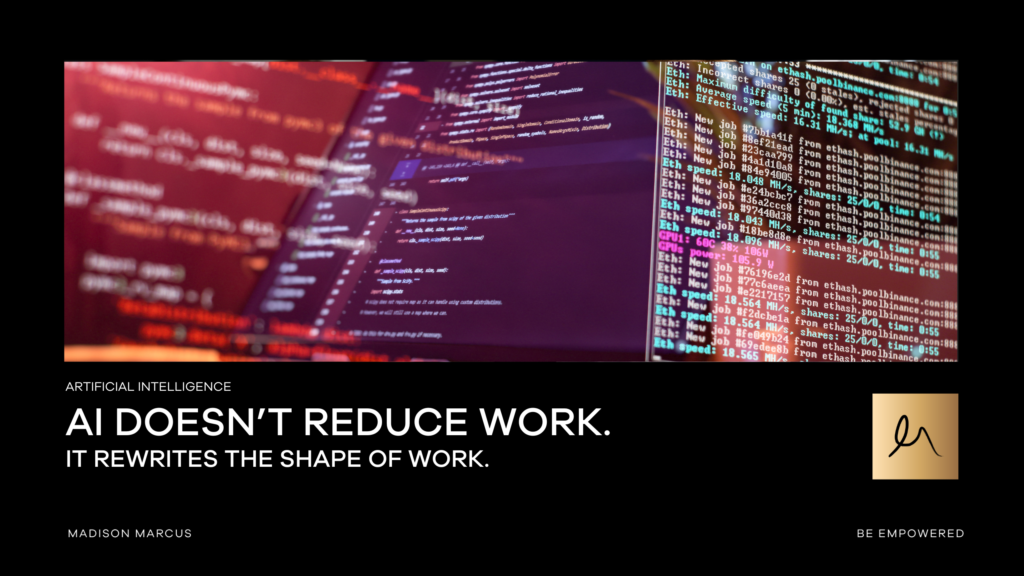
AI does not reduce work.
It rewrites its shape.
And when the shape changes, architecture matters.
¹ AI Doesn’t Reduce Work—It Intensifies It, Harvard Business Review (February 2026) https://hbr.org/2026/02/ai-doesnt-reduce-work-it-intensifies-it