

Employers often ask what they must do when an employee needs time off to perform jury duty (“the duty”). A recent prosecution of a Sydney bookshop owner highlights why employers must handle jury service carefully and lawfully.
Across Australia, employers must allow employees to attend jury duty. Employees must notify their employer as soon as possible and provide proof of their jury service.
The law also protects employees from retaliation. Employers must not dismiss an employee, disadvantage them, or change their role or conditions because of jury service. Employers who breach these obligations expose themselves to serious legal consequences.
These consequences arise under both employment law and criminal law.
Protection Against Employer Retaliation
Employers who punish employees for attending jury duty risk:
- Unfair dismissal claims
- Adverse action claims under the Fair Work Act 2009 (Cth)¹
- Criminal prosecution under state jury legislation
In New South Wales, the law treats jury protection as a serious obligation.
Section 69A – Jury Act 1977 (NSW)
Section 69A of the Jury Act 1977 (NSW)² makes it a criminal offence for an employer to punish a juror. An employer commits an offence if they:
- Dismiss an employee
- Injure an employee in their employment
- Alter an employee’s position to their detriment
where the conduct occurs because the employee attended jury duty.
The law exists to ensure employees can perform jury service without fear of reprisal.
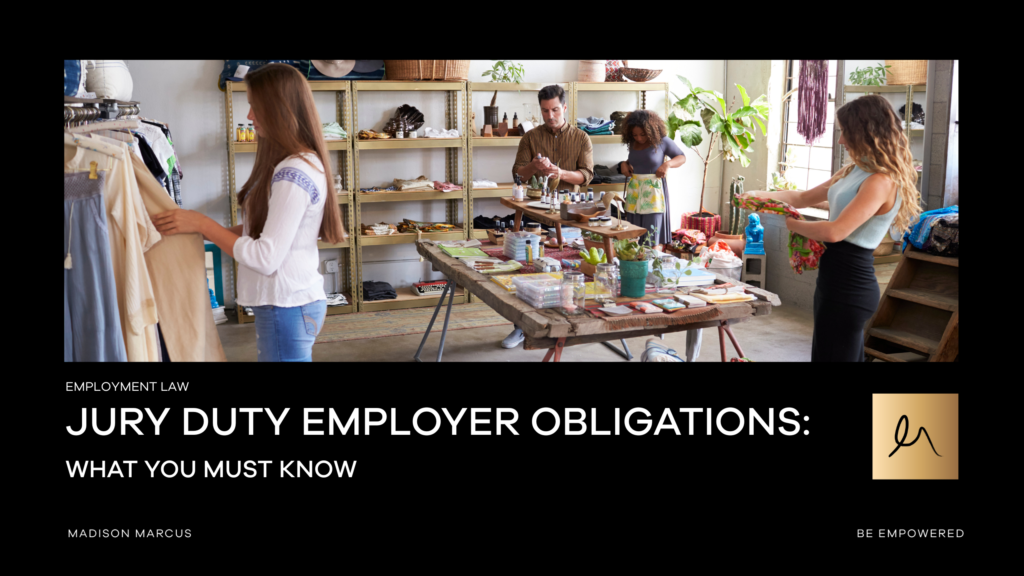
The Vintage Clothing Shop Case
A case reported by The Guardian³ shows how these laws operate in practice.
A Sydney vintage clothing shop owner faced prosecution after threatening an employee who served as a juror in a murder trial.
Key facts
- The Supreme Court of New South Wales empanelled the employee on a murder trial.
- The trial ran for eight weeks in early 2023.
- The Trial Judge advised jurors to rest on weekends due to the violent evidence.
- Despite this direction, the employer rostered the employee to work three out of every four weekends during the trial.
- During the trial, the employer emailed the employee and accused her of breaching company policy by not working her usual hours.
- When the employee returned to work, the employer issued a letter requiring her to attend a disciplinary meeting, with possible outcomes including termination.
The employee told the Court she felt unfairly punished and resigned.
Although the public reporting does not detail how authorities became involved, the matter proceeded to prosecution.
Court outcome
- Prosecutors charged the company, not an individual director.
- The Downing Centre Local Court heard the matter on 27 August 2024.
- Magistrate Scott Nash found the employer guilty of threatening an employee while she performed jury duty.
- The Court listed sentencing for 19 November 2024.
The employer argued the juror finished at 4:00 pm on Fridays and could work weekends. The prosecution argued the juror needed rest due to mental exhaustion.
The Court accepted the seriousness of the employer’s conduct.
Why This Case Matters for Employers
This case sends a clear warning to employers:
- Jury duty is a protected civic obligation
- Employers must not interfere with it
- Law enforcement will prosecute corporate entities, not just individuals
In New South Wales, employers face fines of up to $22,000 and 12 months’ imprisonment for threatening or punishing an employee because of jury service.
Jury Duty and Pay Obligations Under the Fair Work Act
Employers must also comply with section 111 of the Fair Work Act 2009 (Cth)⁴.
Key obligations include:
- Employers only pay “make-up pay” to full-time and part-time employees
- Casual employees do not receive make-up pay
- Employers pay make-up pay for the first 10 days of jury selection and service
- Employers may require employees to:
- take reasonable steps to obtain jury attendance pay
- provide evidence of the jury pay received or payable
- Employers may refuse make-up pay if the employee cannot provide evidence
These rules balance employer cost exposure with employee entitlements.
Practical Guidance for Employers
To reduce legal risk, employers should:
- allow employees to attend jury duty without pressure
- avoid rostering or performance decisions that undermine jury service
- never link disciplinary action to jury attendance
- obtain legal advice before acting
How Madison Marcus Can Help
Jury service issues carry real legal and reputational risk for employers. Our employment law team advises Sydney-based businesses on jury duty obligations, disciplinary processes, and compliance strategies.
If you need guidance before acting, contact Madison Marcus. Early advice can prevent criminal exposure, employee claims, and reputational damage.
Protect your business by getting the advice right from the start.
¹ Fair Work Act 2009 (Cth), available at https://www.legislation.gov.au/C2009A00028/2017-09-20/text
² Jury Act 1977 (NSW) s 69A, available at https://classic.austlii.edu.au/au/legis/nsw/consol_act/ja197791/s69a.html
³ Josh Butler, ‘Sydney vintage shop threatened employee who took weekends off while serving on trial jury’, The Guardian (27 August 2024), available at https://www.theguardian.com/australia-news/article/2024/aug/27/sydney-vintage-shop-threatened-employee-who-took-weekends-off-while-serving-on-trial-jury-ntwnfb
⁴ Fair Work Act 2009 (Cth) s 111, available at https://classic.austlii.edu.au/au/legis/cth/consol_act/fwa2009114/s111.html