
Case analysis | Construction Law, Product Liability and Australian Consumer Law | October 2026
The Owners – Strata Plan No 87231 v 3A Composites GmbH (No 10) [2026] FCA 351
Introduction
In a significant decision for Australia’s construction industry, the Federal Court has clarified the circumstances in which manufacturers and suppliers of building products may be liable under Australian consumer protection legislation where those products are alleged to present a fire safety risk.
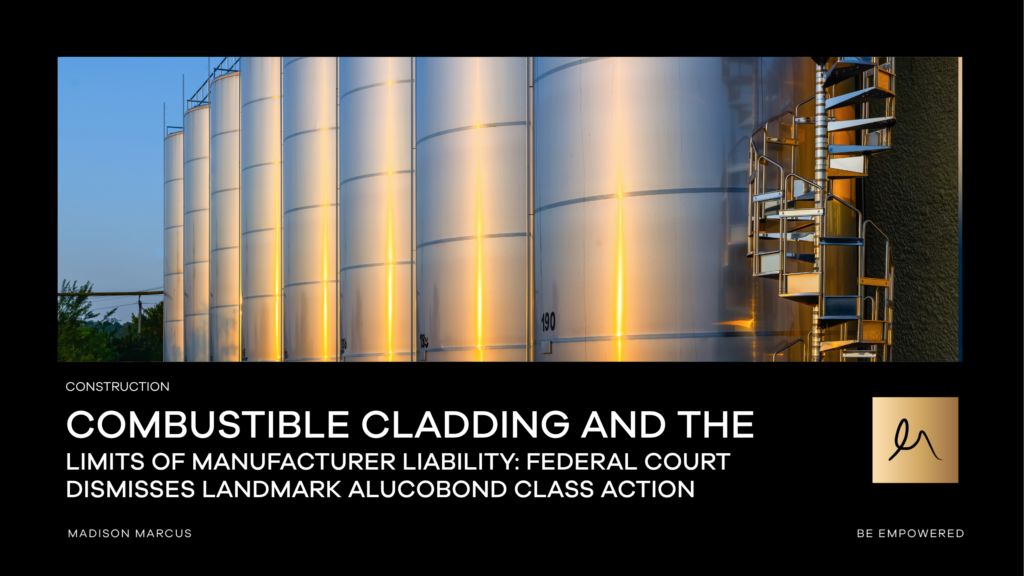
In The Owners – Strata Plan No 87231 v 3A Composites GmbH (No 10) [2026] FCA 351, delivered on 27 March 2026, Justice Anderson dismissed representative proceedings brought against the manufacturer and Australian distributor of two aluminium composite panel (ACP) cladding products, Alucobond PE and Alucobond Plus.
The applicants alleged that the products were inherently unsafe, failed to satisfy statutory guarantees of acceptable or merchantable quality, and had been marketed through misleading representations concerning their safety, suitability and compliance with applicable building standards.
The Court rejected those claims, finding that the products were capable of safe and compliant use and that their suitability depended upon the circumstances of their application to individual buildings.
The decision is particularly important because it distinguishes between a product that is inherently defective and a product that may become unsafe when incorrectly specified, designed, installed or used.
It also raises important questions concerning the allocation of responsibility between manufacturers, distributors, architects, builders, fire engineers, certifiers and other construction professionals.
Background to the proceedings
The litigation arose against the backdrop of increasing scrutiny of combustible external cladding following major building fires in Australia and overseas, including the 2014 Lacrosse apartment building fire in Melbourne and the 2017 Grenfell Tower fire in London.
These incidents prompted widespread concern about the use of aluminium composite panels containing combustible core materials, particularly on multistorey buildings.
The proceedings concerned two products manufactured by German company 3A Composites GmbH and supplied in Australia by Halifax Vogel Group Pty Ltd (HVG):
- Alucobond PE, an aluminium composite panel incorporating a polyethylene core; and
- Alucobond Plus, an aluminium composite panel incorporating a mineral-filled core with different fire-performance characteristics.
The proceedings were brought under Part IVA of the Federal Court of Australia Act 1976 (Cth) on behalf of owners and other persons with proprietary interests in buildings incorporating the relevant products.
The applicants sought to establish liability based substantially on the characteristics of the products themselves, rather than by proving individual failures in the design or construction of each affected building.
This approach was central to the litigation. If the applicants could demonstrate that the products were inherently unsuitable or unsafe, they could potentially establish common questions of liability across a substantial class of affected building owners.
Conversely, if the products were capable of safe and compliant use, determining liability would require consideration of the circumstances of individual buildings, including their design, construction, fire safety systems and applicable regulatory requirements.
That distinction ultimately proved decisive.
The principal legal issues
The proceedings raised several interrelated questions:
- Whether the Alucobond products failed to satisfy the statutory guarantees of acceptable quality under section 54 of the Australian Consumer Law (ACL), or merchantable quality under the former section 74D of the Trade Practices Act 1974 (Cth).
- Whether the manufacturer and distributor had engaged in misleading conduct or made false representations concerning the products’ safety, suitability and compliance with building standards.
- Whether any alleged defect or misrepresentation caused compensable loss to the applicants and group members.
- Whether the statutory claims were affected by limitation periods, including the timing of amendments to the class definition.
- Whether the proceedings were suitable for determination on a representative basis given the substantial differences between the buildings concerned.
These issues required the Court to examine not only the physical properties of the products, but also the regulatory and professional environment in which construction products are selected and used.
The Court’s reasoning
1. Acceptable quality does not require a product to be free from all risk
Section 54 of the ACL provides a statutory guarantee that goods supplied to a consumer in trade or commerce will be of acceptable quality.
The assessment includes whether goods are safe, durable, free from defects and fit for the purposes for which goods of that kind are commonly supplied, having regard to the circumstances specified in the legislation.
The applicants contended that the fire-related characteristics of the Alucobond products rendered them inherently unsafe and therefore incapable of satisfying the statutory guarantee.
Anderson J rejected that proposition.
A central feature of the Court’s reasoning was the distinction between the inherent characteristics of a product and the consequences of its use in a particular application.
The expert evidence established that the products were capable of being used safely and consistently with the Building Code of Australia (BCA). Their fire performance depended upon matters including the building’s characteristics, façade design and the applicable fire safety requirements.
The Court considered that the potential for a product to be used inappropriately did not necessarily render it unacceptable or unmerchantable.
Importantly, the statutory guarantee did not require manufacturers to ensure that their products would be safe in every conceivable application, including applications that were inconsistent with regulatory requirements.
The decision therefore reinforces the proposition that the existence of a foreseeable risk arising from misuse does not, without more, establish that a product is defective.
2. The reasonable consumer may be a qualified construction professional
One of the more significant aspects of the judgment concerns the identity and characteristics of the hypothetical reasonable consumer.
The applicants’ case necessarily invited consideration of whether ordinary building owners would regard combustible cladding as acceptable.
However, the Court considered the expectations of the professionals responsible for selecting, specifying, designing and certifying the relevant building products.
Those professionals could reasonably be expected to possess knowledge of construction materials, fire safety requirements, applicable standards and the need to assess product suitability for particular applications.
Anderson J concluded that a reasonable qualified professional would not expect a construction product to be suitable for every building or every possible application.
This is an important development in the application of section 54.
It demonstrates that the reasonable consumer assessment may be informed by the sophistication, expertise and knowledge of the relevant market.
For specialised construction products, the statutory inquiry may therefore differ materially from the assessment applicable to ordinary household consumer goods.
However, the judgment should not be interpreted as establishing that manufacturers of products supplied to professionals are exempt from the consumer guarantees.
Rather, professional knowledge forms part of the circumstances relevant to determining what constitutes acceptable quality.
3. The role of building regulations and professional responsibility
The Court placed considerable emphasis on the regulatory framework governing building design and construction.
The BCA establishes requirements that must be considered when selecting materials and designing building systems. Compliance may depend upon the overall design and performance of a building rather than the characteristics of an individual component considered in isolation.
The Court’s reasoning recognised that architects, engineers, builders and certifiers have distinct responsibilities in determining whether particular products may lawfully and safely be incorporated into a building.
A product that is suitable for one application may be unsuitable for another.
Consequently, it was insufficient for the applicants to establish that the products had combustible characteristics or that their use could create fire safety risks in certain circumstances.
The applicants needed to establish that the products failed to satisfy the applicable statutory quality requirements.
The Court was not persuaded that they had done so.
This reasoning is particularly significant in construction litigation because it recognises that a completed building is the product of multiple professional decisions and interconnected systems.
It also suggests that, where the alleged defect arises from the selection or incorporation of an otherwise compliant product, responsibility may lie with those responsible for the building’s design, specification or construction.
That does not mean manufacturers can never be liable for combustible building materials. Liability remains possible where a claimant establishes an inherent defect, misleading representations or another actionable breach.
4. The defence under section 271(2) of the ACL
A further important aspect of the decision concerns section 271(2) of the ACL.
That provision can exclude manufacturer liability for damages under section 271 where the failure to comply with the guarantee of acceptable quality occurred only because of an act, default or omission of another person, or a relevant cause independent of human control, after the goods left the manufacturer’s control.
Although the applicants failed to establish a breach of the guarantee, Anderson J considered the operation of the statutory defence.
His Honour concluded that, had the products failed to satisfy the guarantee solely because of the acts or omissions of qualified professionals, the defence would have been available.
This finding is significant because it recognises the potential operation of section 271(2) where an otherwise acceptable product becomes unsuitable through the conduct of persons involved in its subsequent use.
The provision is not, however, a general immunity for manufacturers whenever another participant in the construction process has contributed to a loss.
Its operation depends upon the statutory requirement that the relevant failure occurred only because of the qualifying intervening conduct or cause.
Where an inherent product defect independently contributes to the failure, the position may be different.
5. Misleading representations and failure to warn
The applicants also alleged that the respondents had made misleading representations concerning the safety, suitability and regulatory compliance of the products.
The claims concerned product literature and marketing materials said to convey that the Alucobond products were appropriate for particular building applications.
The Court rejected the applicants’ misleading conduct case.
An important consideration was the context in which the representations were made and the identity of their intended audience.
The relevant materials were directed substantially towards qualified construction professionals who were expected to understand that the suitability of a particular product depended upon the applicable regulatory requirements and the circumstances of the proposed building.
Accordingly, the Court did not accept that the materials conveyed the broad, unconditional assurances of safety and compliance alleged by the applicants.
The Court also rejected the contention that the absence of particular warnings rendered the conduct misleading.
In the circumstances, the qualified professionals to whom the materials were directed could reasonably be expected to understand the relevant limitations on product use.
The judgment illustrates that misleading conduct claims must be assessed by reference to the overall context of the representation, including the knowledge and characteristics of its intended audience.
It also reinforces the need for plaintiffs to identify precisely the representations alleged, establish why they were misleading and prove the necessary causal connection with the loss claimed.
6. Causation and limitation periods
Even where a statutory contravention can be established, a claimant must still demonstrate that the contravention caused the relevant loss.
The applicants encountered difficulties in establishing the connection between the alleged representations and the decisions made during the design, specification and construction of individual buildings.
The involvement of multiple professional participants complicated the causal inquiry.
The judgment also addressed limitation questions arising from the commencement and subsequent amendment of representative proceedings.
Of particular importance was the Court’s treatment of amendments to the class definition and the knowledge relevant to limitation periods under the ACL.
The Court held that amendments to the class definition did not necessarily operate retrospectively from the commencement of the proceeding for limitation purposes.
The decision also considered the knowledge required to trigger the limitation period under section 273 of the ACL, distinguishing awareness of non-compliance with a consumer guarantee from knowledge of the precise defect or legal responsibility.
These findings underscore the importance of careful class definition, timely commencement of proceedings and the identification of when affected persons acquired the knowledge required by the relevant statutory limitation provisions.
Implications for the construction industry
The decision has significant practical implications for manufacturers, construction professionals, owners’ corporations and parties involved in building defect litigation.
Manufacturers and suppliers
Manufacturers and suppliers may rely on the distinction between inherent product defects and inappropriate downstream use when defending consumer guarantee claims.
However, they should continue to ensure that product literature accurately describes the product’s characteristics, limitations and conditions of use.
The decision does not remove obligations concerning product safety or misleading representations.
Architects, engineers, builders and certifiers
The judgment highlights the importance of professional decision-making in the selection and incorporation of construction products.
Where product safety depends upon the circumstances of use, the adequacy of design decisions, specification, certification and installation may become central to determining responsibility.
The decision may therefore increase scrutiny of the conduct of construction professionals in litigation concerning combustible cladding and other building materials.
Owners’ corporations and building owners
For owners’ corporations, the decision demonstrates the difficulties of establishing a product liability claim based solely on the presence of a potentially hazardous building material.
It may be necessary to obtain building-specific expert evidence addressing the applicable regulatory requirements, the product’s use, the cause of any non-compliance and the resulting loss.
Potential claims against builders, developers, designers and certifiers may require separate consideration, subject to the relevant statutory duties, contractual arrangements and limitation periods.
Class action litigation
The decision also illustrates the difficulties of using representative proceedings to resolve building defect disputes involving materially different buildings.
Although the same product may have been incorporated into numerous buildings, questions of regulatory compliance, causation and loss may depend upon individual building characteristics.
As Anderson J observed at [14], the proceedings involved highly individual factual issues.
The existence of a common product does not necessarily establish a common defect or a common basis of liability.
Critical analysis: Has the Court shifted responsibility away from manufacturers?
The decision raises a broader question about the allocation of responsibility for construction product safety.
On one view, the judgment reflects a principled application of the consumer guarantees. Manufacturers should not automatically be liable merely because a product is capable of unsafe use. Construction materials are frequently designed for particular applications, and their suitability necessarily depends upon competent professional assessment.
This approach recognises the complexity of modern construction and avoids treating manufacturers as guarantors of the regulatory compliance of every building incorporating their products.
On another view, the decision may present substantial evidentiary challenges for building owners seeking remedies for products associated with serious safety risks.
A product may be capable of safe use in some circumstances but nevertheless present foreseeable risks when used in the applications for which it is commonly marketed or supplied.
The critical issue is therefore whether the capacity for some safe and lawful use should be sufficient to defeat an allegation of unacceptable quality, or whether greater weight should be given to the product’s foreseeable and ordinary commercial applications.
The answer should depend upon the statutory test and the evidence in each case.
The judgment should not be read as establishing a universal rule that any product capable of safe use must necessarily be of acceptable quality.
Rather, the Court’s conclusion was reached in the particular factual and evidentiary context of the Alucobond proceedings.
There is also an important distinction between the failure of the applicants’ product liability claims and a positive finding that every building incorporating the products is safe or compliant.
The Court did not determine that all affected buildings satisfied the applicable fire safety requirements.
Its conclusion was that the applicants had not established the pleaded statutory causes of action against the respondents.
That distinction will be important in future litigation.
Conclusion
The Owners – Strata Plan No 87231 v 3A Composites GmbH (No 10) [2026] FCA 351 represents an important development in Australian construction and consumer law.
The decision confirms that the assessment of acceptable quality for specialised building products requires consideration of the products’ intended uses, the knowledge of relevant professional consumers and the regulatory environment in which the products are supplied and incorporated into buildings.
It also demonstrates the importance of distinguishing an inherent defect from risks arising through inappropriate specification, design or installation.
For building owners and their legal advisers, the judgment highlights the need to carefully identify the source of the alleged defect, the parties responsible for it and the evidence necessary to establish causation.
For manufacturers and suppliers, it provides guidance on the limits of statutory liability where products are capable of safe and lawful use but may be misapplied by others.
Ultimately, the case reinforces a fundamental principle of construction litigation: the fact that a building contains an unsafe or non-compliant component does not, without more, establish that the manufacturer of that component is legally responsible for the resulting defect.
The applicants have appealed Anderson J’s decision. We will provide an update following the determination of that appeal.

Tim Sargeant: Partner, Commercial Litigation & Insolvency
Tim is a commercial litigation and corporate insolvency specialist. He has over 20 years’ experience advising and assisting clients in a wide range of commercial and civil matters and disputes. He also acts for a number of insolvency practitioners in addition to advising private clients on insolvency related issues.
Tim has gained extensive experience working at leading law firms. As a solicitor, he understands the importance of not only providing sound legal advice, but also sound business advice, and has a reputation for exceptional commitment to client service.
Tim’s expertise includes alternative dispute resolution, contract disputes, disputes involving claims and defences under the Corporations Act, finance default proceedings, including recovery of security, appointment of receivers, realisation of assets and mortgagee sales, and insolvency matters, including advising administrators and liquidators.