
By Foundry Labs
If you watched the recent Channel 7 segment on artificial intelligence, the narrative will sound familiar: AI is coming, white‑collar roles are under threat, and the labour market is about to be reshaped. It’s a storyline that now appears regularly across media coverage, often framed around layoffs in technology and professional services.
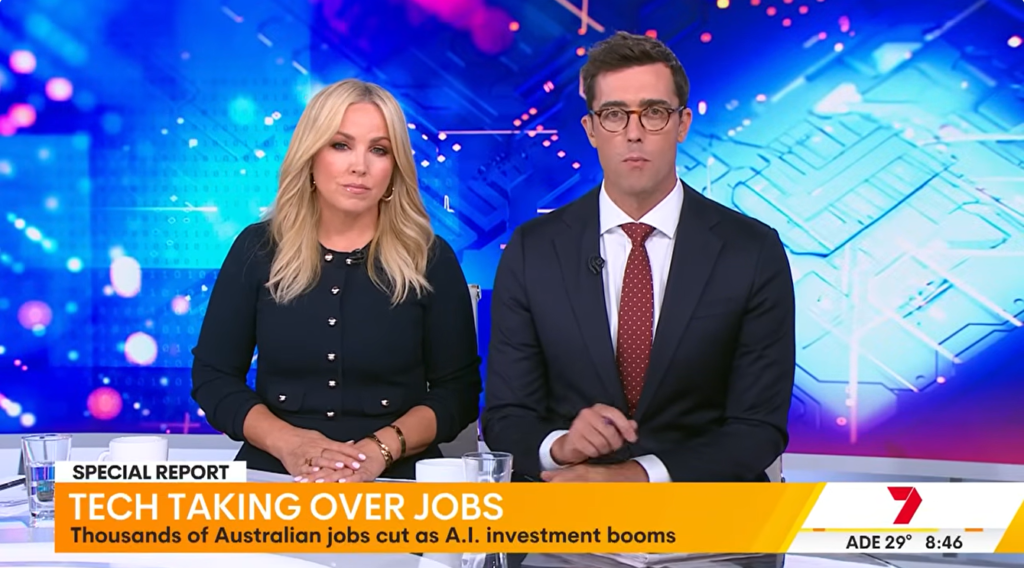
Watch the segment here: AI job cuts spark workforce anxiety across Australia
But the public conversation has become increasingly confused. In the same breath we hear that AI is unreliable, overhyped and nowhere near capable of replacing professionals, while also being told it is already responsible for large‑scale job losses. Those two claims sit uneasily together.
The reality is far less dramatic and far more familiar. Many of the workforce reductions seen in the past two years are far more closely tied to post‑pandemic overhiring, tighter macroeconomic conditions and management decisions made during the era of cheap capital. AI has simply arrived at the same moment and has become an easy explanation. We’ve written previously about this dynamic, blaming AI for layoffs often obscures the far more ordinary business reasons behind them.
But focusing solely on job cuts misses the deeper shift underway. The more important question is not “Will AI eliminate roles?” but rather “How will work itself be redesigned?”
And that is where the real transformation is beginning.
We’ve Seen This Pattern Before
Whenever industrial-scale technology arrives, the first reaction is fear.
The printing press threatened scribes… automation threatened factory workers… computers threatened clerical roles.
And yet, history rarely unfolds as a simple story of disappearance. Instead, it becomes a story of reconfiguration.
Roles evolved, tasks shifted, and entire industries emerge around capabilities that previously didn’t exist.
AI is simply the latest chapter in that long arc, but what makes this moment different is speed and accessibility.
Jobs Are Not Roles – They Are Collections of Tasks
One of the biggest misconceptions in the AI debate is that we talk about jobs as if they are single activities.
They’re not.
Every profession is really just a bundle of tasks.
A lawyer doesn’t just practise law. They research, analyse documents, draft text, structure arguments, communicate with clients and coordinate with colleagues.
A financial analyst doesn’t just analyse markets. They gather data, build models, write commentary, interpret results and explain insights.
AI is not eliminating those professions overnight. But what it is doing is changing the cost, speed and potential quality of many of those tasks.
Some tasks will indeed become dramatically cheaper and faster to perform. But it would be a mistake to assume that every activity will suddenly cost less. Certain forms of work, particularly those requiring judgement, oversight and interpretation, may actually become more valuable.
There is also an economic dynamic at play that economists have observed repeatedly: Jevons’ Paradox.
When something becomes cheaper or more efficient to produce, demand for it often increases rather than decreases. For example, if AI makes research faster, organisations will simply conduct more research or if analysis becomes easier, companies will run more scenarios. The volume of work expands.
At the same time, the quality bar rises. A task that once produced a simple output, perhaps a short memo, a single analysis, or a narrow report, can now incorporate far more information, context and modelling.
The expectation shifts from “good enough” to “comprehensive”.
This is particularly important in industries that were already operating under pressure to deliver more with fewer resources.
Legal teams, financial analysts, consultants and corporate functions have spent years being asked to increase productivity without increasing headcount.
In that context, AI is not simply a threat.
For many organisations, it is a long‑awaited productivity release valve.
The Junior Talent Question Is Real
One legitimate concern in this transition is the impact on junior professionals. Historically, early-career roles were built around repetition: reviewing documents, preparing research briefs, building spreadsheets and drafting early versions of analysis. These activities were not glamorous, but they formed the apprenticeship layer of many professions.
As AI accelerates parts of this work, the pathway into expertise will inevitably change. The answer is not to remove juniors from the system but to redesign how they learn, shifting earlier towards interpretation, validation, systems thinking and judgement. The apprenticeship model does not disappear; it simply evolves.
The Real Opportunity: A Lower Barrier to Creation
While much of the public debate focuses on displacement, something equally important is happening beneath the surface: the barriers to building things are collapsing. Tasks that once required specialised teams, expensive infrastructure and months of development can now often be prototyped by small teams, or even individuals, using modern AI tools and modular technology stacks.
This shift changes who gets to participate in innovation. Capabilities that previously sat inside large technology firms or well-funded startups are increasingly accessible to professionals, small teams and domain experts who simply understand the problem they are trying to solve.
This is why we often describe today’s technology landscape as a set of LEGO blocks. APIs, models, data platforms and developer tools can be combined in ways that dramatically expand what people are able to create. The result is not just efficiency, it is a widening of who gets to build, experiment and bring new ideas to life.

Creativity and Learning in an AI World
Much of the public discussion around the future of work emphasises a return to creative or hands-on professions. That instinct is understandable, but creativity is not limited to physical craft. It also lives in systems thinking, problem-solving and the ability to design new ways of working. Increasingly, that creativity is expressed through technology.
Today, professionals can build applications, design workflows, analyse complex datasets and prototype new services in ways that would have been unimaginable only a decade ago. The tools available are expanding what people can do with their ideas, turning technical capability into another medium for creativity.
This is why the question should not be “Why learn AI if it will do everything anyway?” History shows the opposite pattern. New tools amplify the people who learn to work with them. Just as spreadsheets transformed finance and the internet expanded communication, AI will reward professionals who combine domain expertise with technological literacy.
The Real Call to Action
AI will absolutely change the labour market.
Some tasks will disappear. Some roles will shrink. Others will expand.
But the bigger transformation is this:
The number of things we can build, analyse and understand is about to increase dramatically.
Which means the opportunity set grows alongside the disruption. And the challenge now isn’t to resist the technology. It is to learn how to assemble the LEGO blocks.
Because the people who do will not just adapt to the future of work… they will help design it.